Wednesday, October 31, 2012

Brie: Un Fromage Historique

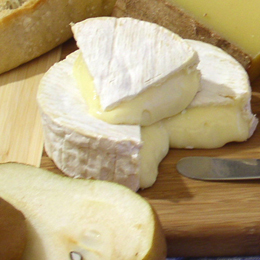
Brie cheese was originated in a French town not far from Paris. The oldest evidence of the cheese's existence was in 774 B.C. where it was first tasted in the city of Brie. Though it is now made pretty much all over the world, France is still the main producer. Brie is made from cow's milk. It is not as rich as some of the other French cheeses. Traditionally, Brie is paired with bread and fruit. Cheeses are usually paired with wines of their same region. Brie is paired with red wines such as Beaujolais.


J'ai vraiment aimé le brie. C'était un fromage très doux. Il goute tres different que autre fromages. Ce n'etait pas riche ou net que autre fromages. Je mangeais de encore. 


Sources:


Camembert: Délicieux Fromage


Camembert
Délicieux Fromage


Camembert cheese was first originated in Normandy by Marie Herel. The cheese comes from unpasterized cow milk that is fermented for months to make its hard crumbly texture. Camembert gets its charistic flavor from the amonia, succinic acid, and salt in it. This gives the cheese a very bland and sometimes bitter taste. The cheese also has a very distinct smell that sometimes also smells like ammonia. Many people like to serve the cheese warm to go with apple slices, dried appricots, and crusty baguettes.

The orange shaded area is Normandy wich is where Camembert originated


These are some examples of what can go with the cheese


Je nai pas comme fromage beaucoup. J'ai comme le fromage sur des sandwichs. Camembert n'a pas bon gout. Camembert aussi sent mauvais. Je voudrais brie fromage le plus.

Sources:

Pont l'Eveque: Le Fromage Sacrée

   
     From twelfth century monks comes "d'Angelot," or the cheese "of angels," as it may be translated. A strong-scented cheese, its flavor highly contrasts the fungus-like aroma it produces. A creamy milk-made texture and soft rind have continued to provide a consistently beneficial consumption for all lovers of "fromage." Often, it is eaten at room temperature, and does not necessarily need any other components, although crackers and wine are a classical tradition. According to ancient historical manuscripts, one monk claimed that any fine meal should conclude with this cheese. Its origins lead to the city-state of Normandy along the northern area of the English Channel, almost parallel to London, England.  In fact,  its unique and classic nutty flavor have earned it the name of the village it was most popularly produced in: Pont l'Eveque. There, (as seen below) along its North Eastern border lies Pont l'Eveque, where its cheese became exceedingly popular in the 17th century. Soon after, as France became a well-established center of finery, "d'Angelot" met all the criteria of one refined food its home country would be known for among thousands of others.


     When sampling this cheese, I personally experienced the unappealing smell it produced foremost. However, as cheese ages, I kept my mind open to tasting all that was presented to me, strong or not. I was exceptionally pleased to find that the flavor was both rich and nutty. Its soft texture was not too creamy or hard, and surprisingly the aroma it produced only added to the subtle hints of France I could literally taste on my tongue. As the monk originators claimed, Pont l'Eveque was truly "sacrée!" France should be proud to own up to such a decadent food. 


For more information on Pont l'Eveque or to view sources follow these links:


Tuesday, October 30, 2012


Boursin: Une Nouvelle Torsion Sur une Vieille Tradition


            The history of Boursin cheese begins long before it actually came into existence.  In Normandy, France there is a long history of making fromage frais, to the point where it is a staple of traditonal cuisine in the region.  Fromage gras is made by taking a seasoned cheese and mixing it with fine herbs. Using this dish as inspiration, Francois Boursin, a cheese maker himself, would develop a new cheese.  In 1957, he released what he would undoubtedly become most known for, Boursin Garlic and Fine Herbs.  It was a smashing success.  Popularity for this new cheese spreaded like wild fire in France, and it became the first flavored cheese to be sold throughout France.  Boursin did not stop there, though, three years later he came up with a pepper-flavored Boursin cheese, and he gained an even larger following. Today, Boursin cheese is sold in over thirty-five countries across five continents.  So, though it may be a relatively recent development in the history of cheese, it appears Boursin is here to stay.


           The flavor of the cheese is incredibly rich.  Also, by the nature of its composition it has a moistness that most cheeses lack.  I enjoy this aspect because if I'm at a party it is nice to have a cheese that does not make me run back to the punch bowl to quinch my parched throat.  The garlic taste is very apparent as well, which I like.  Overall, it is a fantastic tasting cheese, and one of my personal favorites.  The one draw back is how filling it is, for if you are not careful you can easily become stuffed with it before dinner


http://www.thriftyfoods.com/EN/main/cook/tips-tricks/cooking-tips/cheese/history-boursin-cheese-20100210.html

Camembert:Le Processus de Vieillissement

Camembert (fresh)
Originating in the Normandy region of France in 1751, Camembert cheeses were named by Napoleon after the specific town where this cheese was created. That town is Camembert, Normandy, home of the creator Marie Harel. Camembert cheese is made using 100% cow milk. This contributes to both the tough, aged rind and the moist, creamy middle. After the three weeks of necessary aging, if the Camembert's maturing process is continued, the cheese becomes creamier and mushier. Even though the texture may change completely, the only true change of flavor is in the richness of the cheese. The flavor that seems to standout to the majority is a ripe but salty taste in each of the Camembert cheeses. With that being said, this cheese is eaten with a variety of things in a variety of ways. Some of these include being spread on baguettes, with a garlic spread and crackers, or with a glass of almost any red wine. Camembert is a fairly neutral cheese that compliments a wide array of foods and beverages.


Normandy, France
The taste reaction is one of succulent delight, causing the diner to want more. Its flavor is salty with a sweet flair. No matter what this cheese accommodates, the taste is always enhanced. One can never underestimate the addition of Camembert cheese to a snack or meal. Each texture brings a slightly different flavor to the table.

Camembert (aged)


Map of Normandy
Facts
How to Eat?
Background and Texture

Brie: Crémeux et fromage


Brie: Crémeux et fromage


Brie Introduction

     Brie is a cow cheese that originated from the Brie historic region of France known for its dairy products. Brie is commonly eaten with crackers and wine traditional. Another possibility is to warm in a croissant or pastry. Brie is known for its creamy texture and slightly sweet taste.

-Region Brie originated
Brie baked inside of a pastry breading
http://www.foodsubs.com/Chesoft.htmlTaste Reaction

 Taste Reaction   

   Brie is very soft and easy to chew. The texture is very creamy and the first bite does taste a little sweet. Its taste and texture seems very similar to cream cheese. I like the taste and it is very filling. With a croissant and heated I think this cheese would taste the best.

Sources

http://www.livestrong.com/article/359332-nutritional-content-of-brie-cheese/
http://avagabonde.blogspot.com/2011/05/eating-le-brie-cheese-while-in-la-brie.html
http://homecooking.about.com/od/cheeseinformation/a/brietips.htm

Wednesday, October 3, 2012

La Belgique: L'union fait la force

La Belgique: L'union fait la force

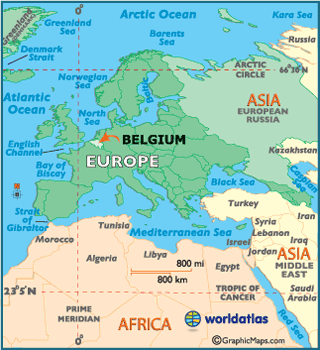
            La capitale de la Belgique est Bruxelles. Les citoyens de la Belgique principalement parlent le néerlandais, le français et l'allemand. De les 10.839.905 personnes qui habitent en Belgique près de 59% parlent le français, 40% parlent le néerlandais et pas plus de 1% parlent l’allemand. Il ya des langues autres que le français, le néerlandais et l'allemand. Les trois langues sont les plus communs. La langue principale et le premier est le néerlandais. La monnaie en Belgique est l'euro. L'hymne de la Belgique est la Brabançonne.


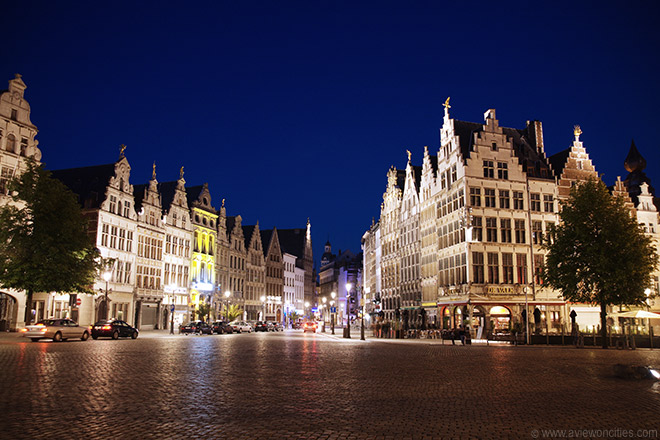
Antwerp est une ville en Belgique.

Ghent est une ville en Belgique.

 La capitale de la Belgique est Bruxelles

Belgium is known for making delicious chocolate 
and French fries, but what they are best known 
for are their Brussels Waffles

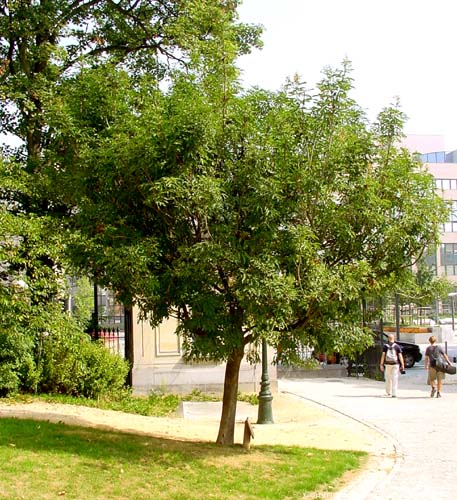
The Sri Chinmoy Peace Tree was planted 
to inspire dreams of world peace.


Vocabulary

Les citoyens: citizens

principalement : mainly

le néerlandais: Dutch

communs: common

principale: main

La monnaie: money, currency

L'hymne: anthem 

L'union fait la force: Strength through Unity 

Websites 

http://en.wikipedia.org/wiki/Belgium#Culture 
http://en.wikipedia.org/wiki/Brussels_waffle#Varieties_of_waffles

Pictures
http://www.worldatlas.com/webimage/countrys/europe/beeu.gif
http://wikitravel.org/upload/en/f/fc/Gentatnight.JPG
http://www.venere.com/img/blog/brussels-night.jpg
http://www.aviewoncities.com/img/antwerp/kvefl3245s.jpg
http://scrapetv.com/News/News%20Pages/Everyone%20Else/images-9/belgian-waffle.jpg
http://belgiumview.com/foto/smvote/0004338aa.jpg

By Hannah Neimy